
Contents
Argentium: Colour
Why is Argentium Silver brighter and whiter than other precious metals?
Argentium's unique formulation enhances the appearance of the silver, giving an incredible natural brightness and lustrous beauty that outshines white gold, platinum, palladium, rhodium and traditional Sterling silver.
How do you measure colour?
This is achieved through a scientific process called the CIELAB standard colour measurement system, using a device called a Colorimeter. The 'dark to light' index (shown as the black to white 'L' parameter on the diagram) is the critical measure used to gauge the level of brightness and the 'yellowness' index (incorporating the blue to yellow 'b' parameter on the diagram) is the critical measure used to gauge the level of whiteness.
Colour test results
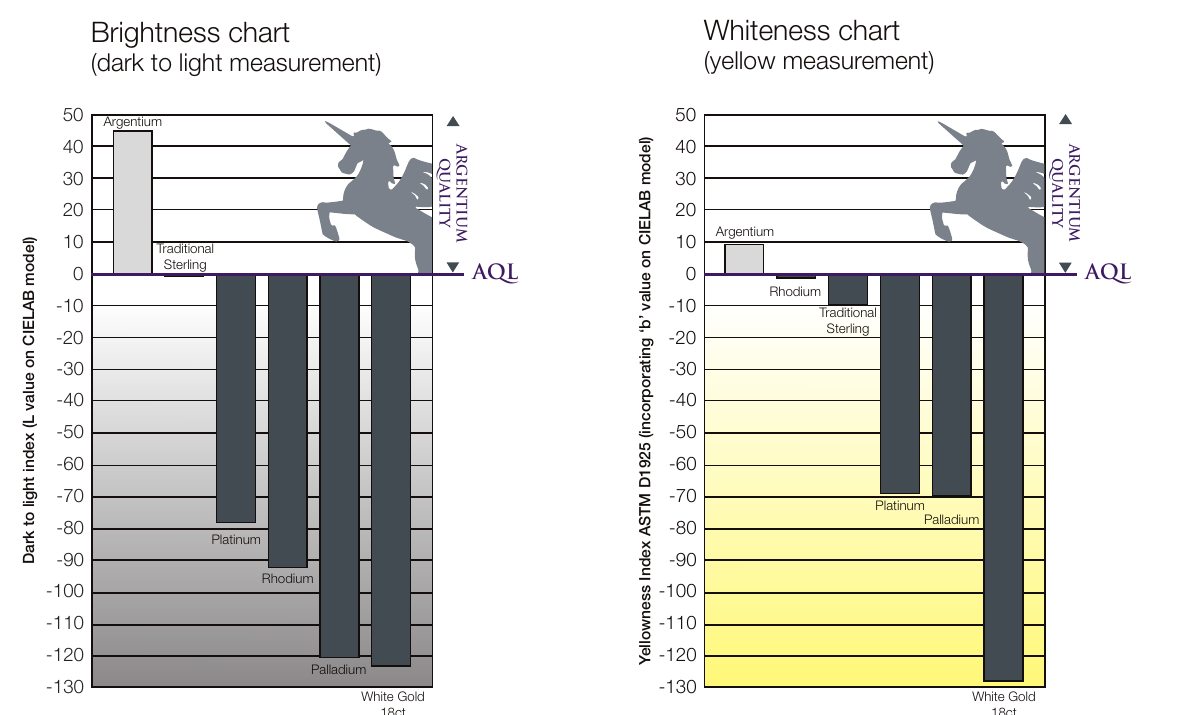
These charts clearly illustrate how Argentium Silver exhibits superior brightness and whiteness in comparison to other precious metals used in the jewellery industry. The Argentium Qualification Lines (AQL) identify set colour measurements required for Argentium Silver.
Argentium: Purity
Argentium is purer than Sterling and Britannia
There are two grades of Argentium Silver:
- Argentium 935 (93.5% minimum silver content)
- Argentium 960 (96% minimum silver content)
Different standards have been established to guarantee and identify the purity of silver articles. Standards include Sterling silver, requiring a minimum of 92.5% silver content, and Britannia silver (UK), which specifies a minimum silver content of 95.8%.
The higher purity Argentium 960 raises the silver level above the prestigious UK Britannia standard.
| Standard | Minimum silver content |
|---|---|
| Sterling silver | 92.5% |
| Argentium 935 | 93.5% |
| Britannia silver (UK) | 95.8% |
| Argentium 960 | 96.0% |
What does this mean for the customer?
Argentium's superior purity ensures that finished items are of the highest quality. Customers are asked to look for the Argentium Winged Unicorn mark on jewellery and silverware as a guarantee that items have been produced with 'the finest silver' in the world.
Argentium: Hardness and Durability
Why are hardness and durability important?
It is beneficial for silver to be soft and malleable where forming and shaping processes are required during the production of jewellery and silverware. However, it is important that finished articles are hard and durable so that they are not vulnerable to damage.
Will Argentium Silver work harden?
Yes. While Argentium has excellent formability in its softened state, the silver will work harden to achieve superior hardness and durability.
Can Argentium Silver be heat hardened?
Yes. Argentium's unique formulation means that the silver can be effectively hardened by a simple, low temperature heat treatment. Unlike traditional Sterling and Britannia silver, even soldered Argentium Silver items can be heat hardened.
What does this mean for the customer?
Finished jewellery and silverware made in Argentium are harder, stronger and more durable than traditional Sterling and Britannia silver. This means that Argentium Silver articles are more resistant to damage from scratches, denting and deformation. This is particularly beneficial for jewellery items that are regularly worn.
Argentium: Tarnish Resistance
Tarnish testing Argentium Silver
It has become the industry norm to test so-called 'tarnish resistant' alloys with a single industry recognised procedure. The Argentium approach, however, is far more demanding and further tests are required to ensure we provide the best quality alloys available today.
The Argentium critical test regime is designed to replicate the effects of environmental pollutants and everyday conditions that cause tarnish. Argentium Silver alloys are required to demonstrate superior tarnish resistance in all of these tests.
The Argentium critical test regime
Sulphur test. Reproduces the effects of sulphur and sulphurous gases found in the atmosphere and everyday substances. This test is based on a standardised corrosion testing procedure used within the precious metals industry.
Perspiration test. Reproduces the effects of perspiration and skin contact with silver alloys. The testing procedure is 'borrowed' from a standardised procedure used in the spectacles industry.
Ultraviolet test. Determines whether alloys are photosensitive to ultraviolet light. This is especially applicable to silver articles that are on display and exposed to sunlight.
How do you measure tarnish resistance?
This is achieved through a scientific process called the CIELAB standard colour measurement system, using a device called a Colorimeter to assess the level of tarnish on each test sample after exposure to the tarnish tests. The 'dark to light' scale (shown as the black to white 'L' parameter on the diagram) is the critical measure used to gauge the degree of tarnish film that has developed on each silver alloy test sample.
Tarnish resistance results
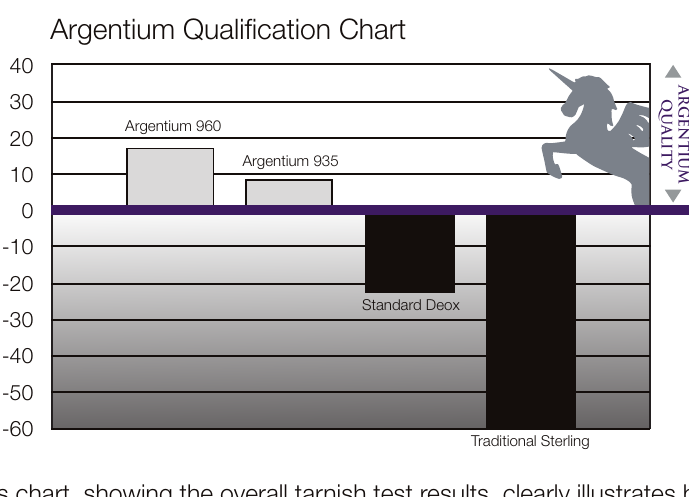
This chart, showing the overall tarnish test results, clearly illustrates how the family of Argentium Silver alloys exhibit superior tarnish resistance.
Argentium alloys are required to pass pre-defined levels on the 'dark to light' scale. This is described as the 'Argentium Qualification Line' (AQL). Alloys that do not meet the AQL in all of the tests do not meet the stringent requirements to be classified as Argentium Silver.
Argentium: Firestain Free
What is firestain?
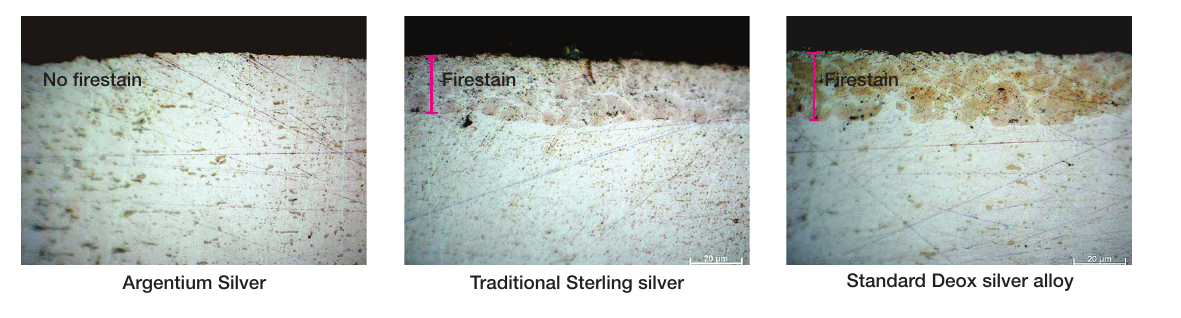
Firestain is a dark coloured, copper oxide stain that forms when Sterling silver articles are heated during production.
Why is firestain a problem?
Firestain can penetrate deep into the surface of silver articles, requiring acids and abrasive processes to remove the stain or plating processes to hide the stain. These procedures, however, not only increase manufacturing time, labour and costs but there are also environmental and workplace concerns associated with hazardous chemicals and practices required for firestain removal and plating.
Firestain test results
The following magnified cross-sections show annealed samples of Argentium Silver, traditional Sterling silver and a standard Deox silver alloy. Penetrating layers of firestain are clearly visible on the traditional Sterling and standard Deox samples. The Argentium Silver sample shows a firestain free surface. Testing was carried out by CATRA, the Cutlery and Allied Trades Research Association, UK.
What are the benefits of firestain free Argentium Silver?
- Argentium does not require acid and abrasive processes to remove firestain or plating processes to hide firestain.
- Manufacturing time, labour and costs are saved.
- Environmental and cost benefits from not having to dispose of toxic chemicals required to remove or hide firestain.
- Workplace benefits from not having to use firestain removal and plating processes.
Argentium: Versatility
Superior alloys for all manufacturing requirements
Argentium offers a range of silver alloys to suit all manufacturing, silversmithing and consumer requirements. Argentium has unique properties including the ability to be welded and fused. This lends the silver to modern technologies and opens avenues for application and design.
How many Argentium alloys are available?
There are four Argentium Silver alloys, each having superior properties to assist manufacturing and to provide consumers with luxury jewellery and silverware items.
| Alloy | Intended for |
|---|---|
| Argentium 935 Millform | Excellent mechanical properties for sheet, wire and tubing applications |
| Argentium 960 Millform | Excellent mechanical properties for sheet, wire and tubing applications |
| Argentium 935 Pro | Professional investment casting alloy, small to high volume production |
| Argentium 960 Pro | Professional investment casting alloy, small to high volume production |
Argentium: Hypoallergenic and Nickel Free
Traditional Sterling silver has long been associated with discolouration where skin and jewellery are in contact, which in certain cases has resulted in the wearer suffering an adverse reaction. There has also been increasing awareness in recent years about the anti-allergy benefits of nickel free silver.
- Argentium Silver is hypoallergenic and is well-suited for those who are unable to wear traditional Sterling silver jewellery. Argentium also has antibacterial properties.
- Argentium Silver alloys do not contain nickel.
Argentium: Responsible Silver
A growing demand for responsible silver
- There is an increasing awareness and demand for the preservation of our natural environment, to conserve energy and natural resources and to reduce waste and pollution.
- Some practices in the silver industry use toxic chemicals and hazardous procedures for removing or hiding firestain, a penetrating, dark coloured oxide that forms when Sterling silver is heated during manufacturing processes. Such practices are undesirable in the workplace and the disposal of toxic waste products also raises environmental concerns.
What makes Argentium Silver responsible?
- Argentium is always made from ethically sourced silver.
- Argentium's excellent firestain resistance makes hazardous processes associated with removing and hiding firestain a thing of the past.
- Argentium's unique and superior properties reduce manufacturing time, labour and resources.