
Metal prices in this article are from 31 August and 1 September 2026. Silver moves daily.
The short answer.
- In India, Argentium 960 lands at roughly 40 to 50 per cent above domestic silver, all in.
- At today's spot, that is about ₹332 per gram delivered, against ₹229 for sterling grain alloyed in India.
- Both metals pay the same Indian import duty, because India imports nearly all its silver. What differs is the value the duty is charged on.
- At the bench, Argentium costs more to set up and less to finish. Per piece, the two roughly cancel.
- The real cost is that it needs a dedicated production line. It cannot be run alongside sterling.
Most writing about the price of Argentium makes the same mistake. It treats Argentium as sterling silver with a premium bolted on, then works the premium out by comparing silver content. Argentium 960 holds 3.78 per cent more silver than sterling 925, so the answer comes out at a few per cent.
That answer is wrong. The real figure in India is 40 to 50 per cent, and this article accounts for every part of it, including the part most often got backwards.
In this guide
Why the sterling comparison is the wrong frame
Sterling silver is a commodity. It is produced everywhere, in enormous volume, from local silver alloyed with copper, which is one of the cheapest industrial metals there is. In India it never crosses a border. It is refined, alloyed and cast within a few hundred kilometres of the bench that works it.
Then, because the copper in it reacts with air, most sterling jewellery is rhodium plated. A few microns of a platinum-group metal are laid over the surface to keep oxygen off it. That coating is the trade's answer to a problem built into the alloy, and it wears through.
Argentium is a different category of product. It is a patented alloy, invented at Middlesex University in London and protected by global patents and trademarks, which cannot legally be produced by anyone unlicensed. It contains germanium, considerably more expensive than copper. It is made in far smaller quantities than sterling. And in India, it has to be imported.
Comparing the two on price per gram is like comparing a coated part with a solid one. They are not the same object at different prices.
What silver itself is doing
Before any Argentium-specific cost, the underlying metal has had the most violent year in four decades.
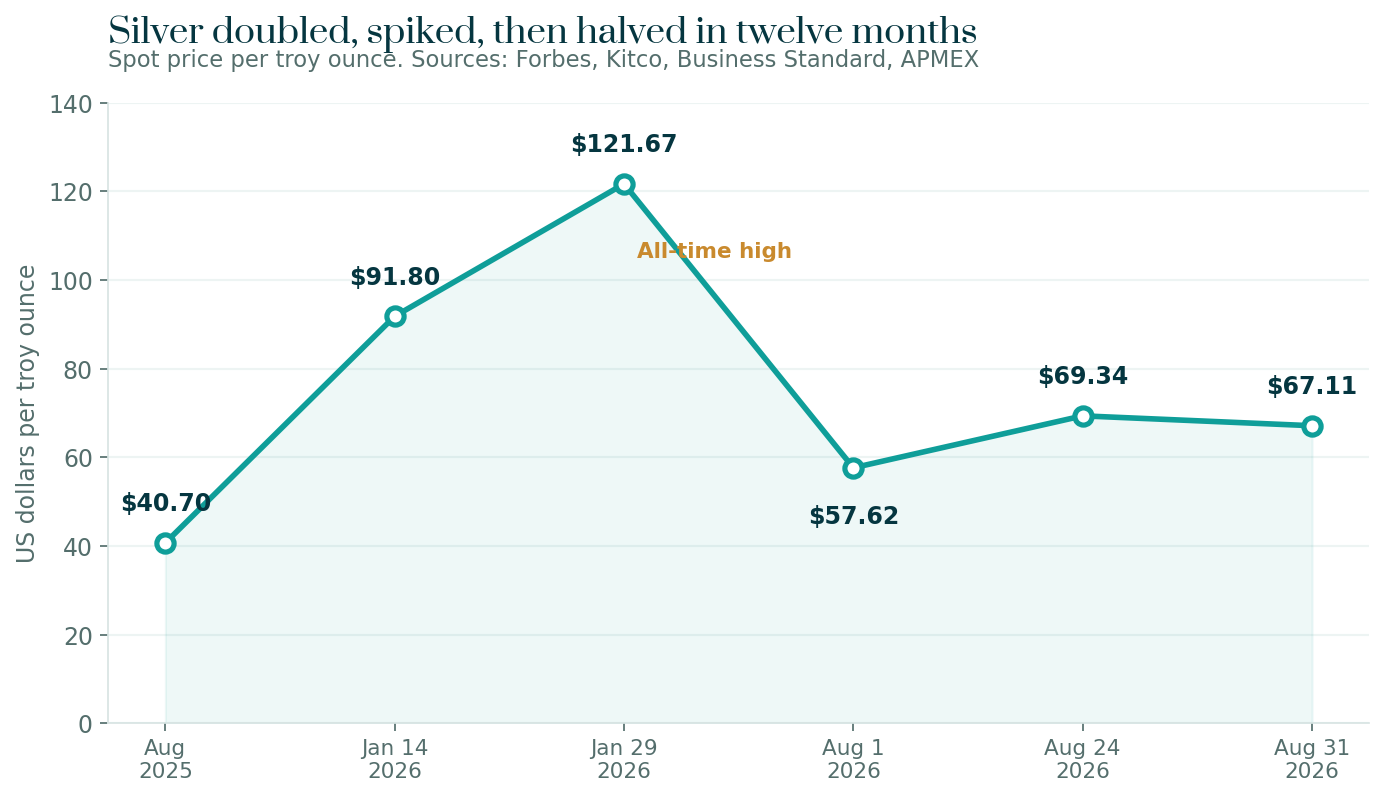
per troy ounce
29 January 2026
a year ago
per gram
Silver was around ₹60,000 per kilogram in India in early 2024. It is around ₹2,50,000 today. The metal component of every silver piece made in this country has roughly quadrupled in two and a half years, and Argentium inherits all of that before a single one of its own costs is added.
The landed cost, line by line
Here is the arithmetic for one gram of each, from the same international silver price, into the same Indian workshop.
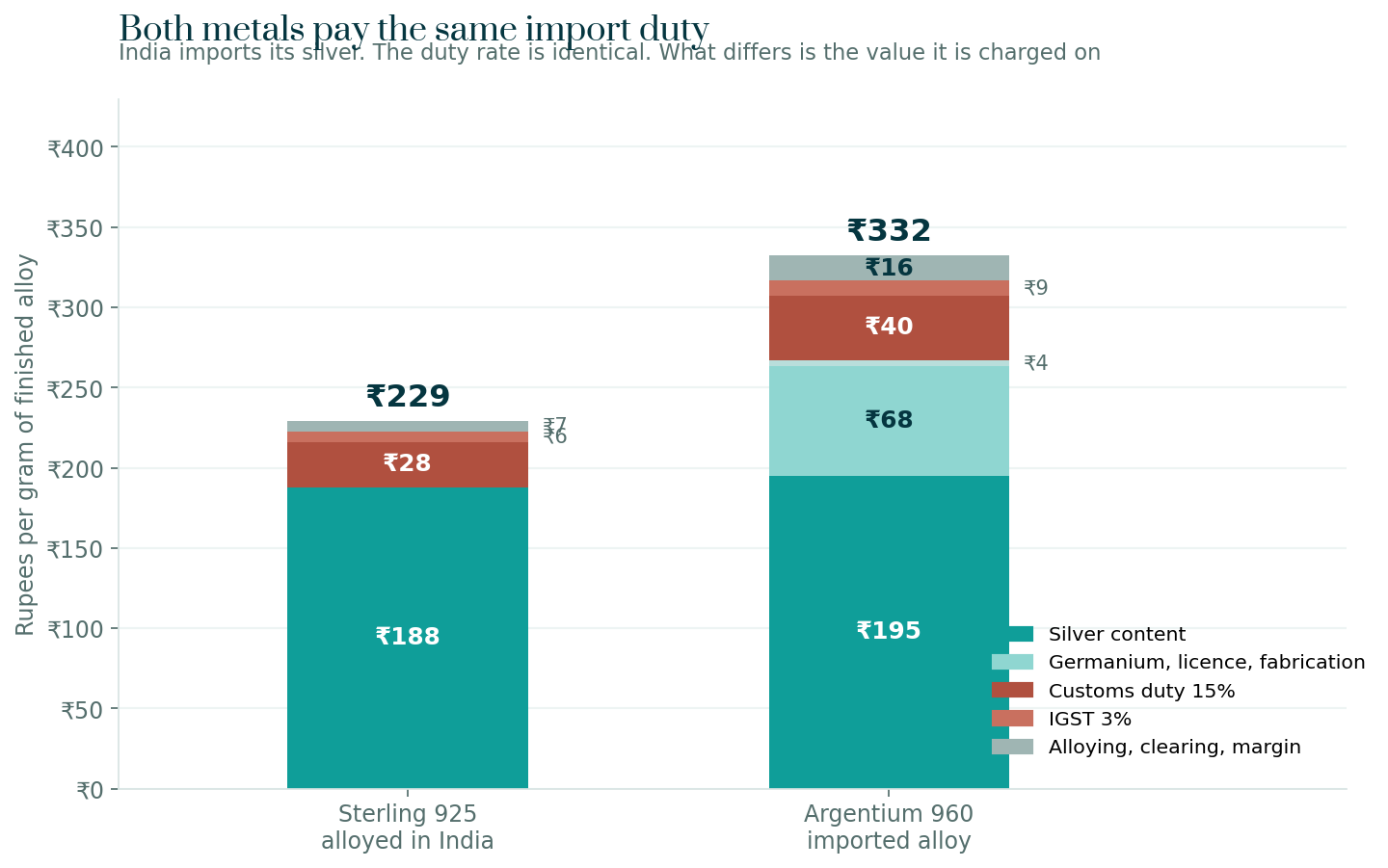
| Line | Sterling 925 | Argentium 960 |
|---|---|---|
| Fine silver, imported | ₹188 | ₹195 |
| Germanium, licence, fabrication | Not applicable | ₹68 |
| Freight and insurance | Not applicable | ₹4 |
| Indian customs duty, 15% | ₹28 | ₹40 |
| IGST, 3% | ₹6 | ₹9 |
| Copper, alloying, clearing, margin | ₹7 | ₹16 |
| Delivered in India | ₹229 | ₹332 |
That is +45 per cent. Move the alloy premium at source between 30 and 40 per cent and the delivered figure moves between +40 and +50 per cent, which is the range anyone actually buying Argentium in India will recognise.
What the duty actually does
It is tempting to point at India's import duty and call it the reason Argentium is expensive. That is not right, and it is worth correcting because the real mechanism is more interesting.
India imports almost all of its silver. The sterling in an Indian workshop is made from imported bullion that paid exactly the same duty. Since 13 May 2026, that is 10 per cent Basic Customs Duty plus a 5 per cent Agriculture Infrastructure and Development Cess, then IGST at 3 per cent on the value plus the duty, giving an effective import burden of about 18.45 per cent. Both metals pay it. The rate is identical.
The difference is what the duty is charged on.
Two different dutiable values.
- Sterling. Duty is charged on fine silver. The metal is then alloyed in India with copper, which costs almost nothing.
- Argentium. Duty is charged on the finished alloy: silver plus germanium, plus the patent licence, plus UK fabrication, plus freight.
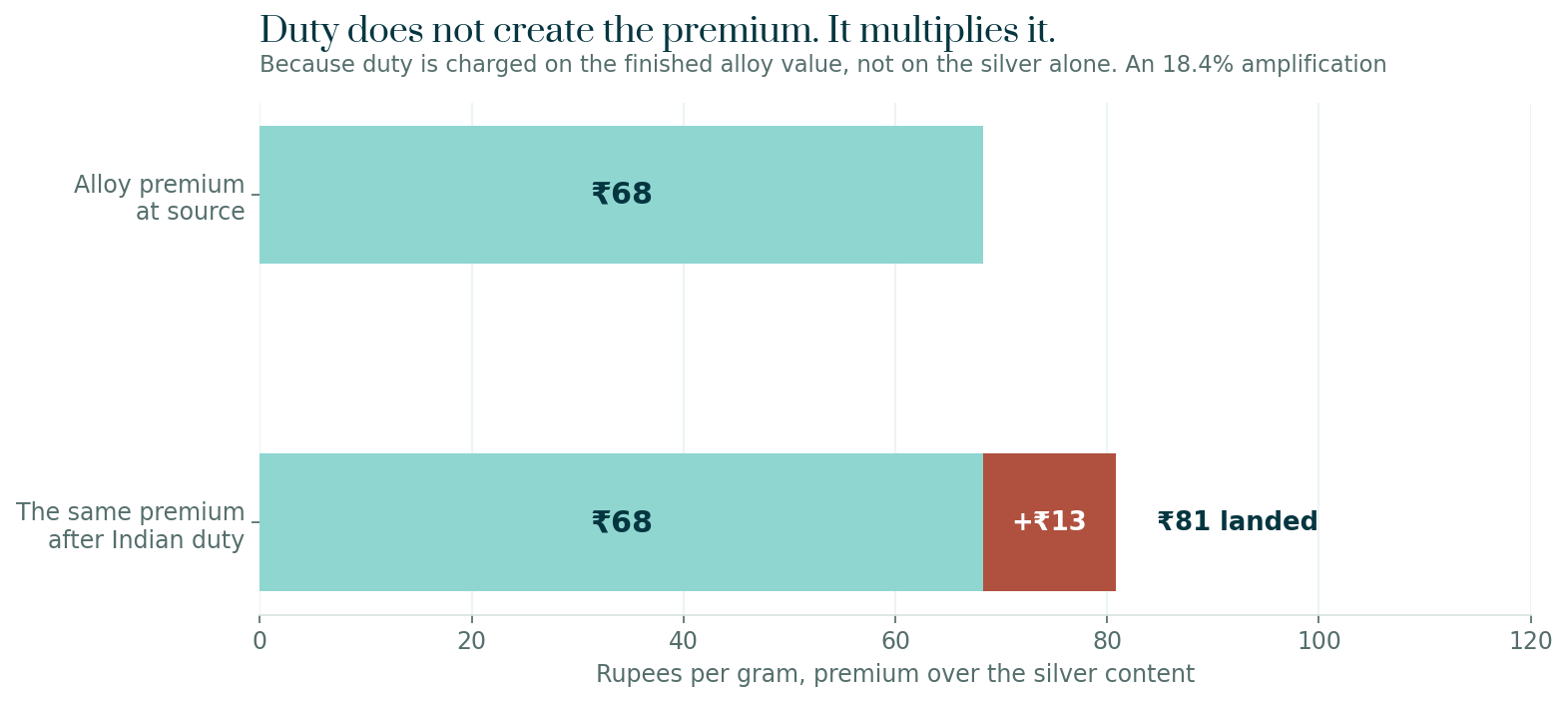
So the duty does not create the Argentium premium. It multiplies it. Every rupee of germanium, licence and fabrication picks up another 18.4 paise on the way through customs, because it is riding inside a dutiable precious metal import rather than being added locally for free.
This is also why the Argentium premium is smaller in the United Kingdom and Europe. It is not that the alloy is cheaper there. It is that it does not pass through a precious metal customs line to reach the bench.
What changes at the bench
Metal cost is only half the story, and it is the half that gets discussed. The other half is that making jewellery in Argentium is technically different from making it in sterling. A workshop that treats them as interchangeable will produce poor work in both.
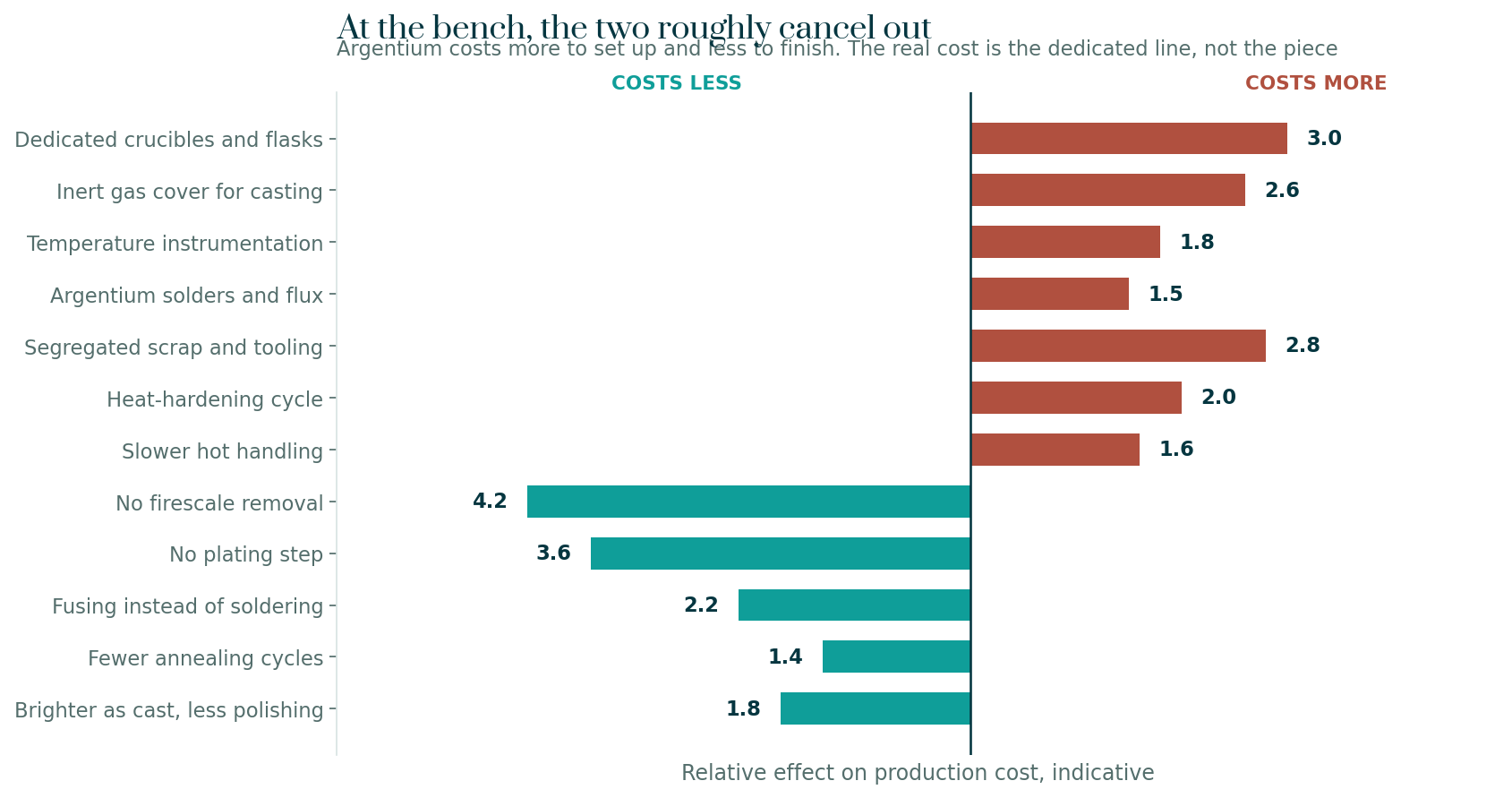
What costs more
| Requirement | Why |
|---|---|
| Dedicated crucibles | Clay graphite or pure graphite only. Silicon carbide is not recommended. They cannot be shared with other alloys. |
| Inert gas cover | Casting is done under argon or nitrogen, and the flask is held under gas for a minute before it leaves the chamber. |
| Temperature instrumentation | Argentium glows paler than sterling at red heat. The silversmith's eye, trained to read colour as temperature, is wrong on this alloy. Accurate readings are needed to avoid overheating. |
| Careful hot handling | It must be securely supported while hot, and cannot be moved, poked or quenched until the red glow has gone. Every hot operation runs slower. |
| Argentium solders and flux | Its own lower-temperature solders. Sterling solder gives a colour mismatch and a compromised join. |
| Segregated scrap and tooling | The most expensive discipline of all. Contamination from sterling, copper or brass, whether through a crucible, a soldering board, a polishing wheel or a scrap bin, degrades the tarnish resistance you paid for. |
| Heat-hardening cycle | An extra oven step, then a slow air cool with no quench. |
| Controlled annealing | Furnace annealing at 600 to 650°C, under an atmosphere that will not strip the germanium oxide layer. |
What costs less
| Saving | Why |
|---|---|
| No firescale | The largest single saving. No aggressive polishing, no acid stripping, no depletion work to remove a subsurface oxide that never forms. |
| No plating step | An entire process removed, with its chemicals, its equipment and its labour. |
| Fusing instead of soldering | Argentium fuses cleanly to itself. No solder seam to hide, no excess to clean up, and often faster than soldering. |
| Fewer annealing cycles | It work hardens more slowly than sterling, giving longer working periods between anneals. |
| Brighter as cast | Less polishing to reach a high finish, because the casting comes out cleaner. |
Add the two columns together and, per piece, they roughly cancel. Which raises the obvious question.
Why it needs a dedicated line
If the bench costs cancel out, why does so little Argentium jewellery exist?
Because those costs are not per piece. They are per workshop. Dedicated crucibles, a separate scrap stream, a separate solder set, an inert gas supply, temperature instrumentation, benches and polishing wheels that have never touched copper: none of it scales with volume. You pay once, and then you keep it separate forever.
Cooksongold, one of the largest bullion suppliers in Europe, states the position without hedging. Argentium requires complete commitment. Mixing standard silver with Argentium, or using shared tools, reduces its effectiveness, and their advice is to switch fully rather than run both.
What that means commercially.
A sterling factory adding Argentium as a side line has two choices. Build a second, parallel workshop. Or accept cross-contamination and quietly ship silver that tarnishes like sterling while being sold as Argentium.
Most manufacturers choose not to offer it at all. A few offer it and cut the corner. That is the real barrier in this category, and it is why a buyer should ask a supplier how their Argentium scrap is stored before asking anything about price.
It is also why Argentia is built on one alloy rather than run as a workshop with an Argentium shelf. The separation is not a marketing position. It is a production requirement.
How a finished quote is built
Everything above is the cost of raw alloy. A finished piece adds three further lines.
| Component | What moves it |
|---|---|
| Metal | Finished weight multiplied by the Argentium rate on the day. Weight is a design decision, not a given. |
| Making | Casting, filing, setting, polishing. Complexity moves this number, not size. |
| Stones | Where the design carries them. Size, cut, type and count. |
| Finishing | Hallmark, packaging, tags, certificate insert. |
Two things follow. First, if a price comes back higher than expected, ask what the piece weighs before asking for a discount. Two pendants of identical visual size can differ by 40 per cent in weight depending on whether they are hollow or solid, and that difference lands entirely in the metal line.
Second, a real precious metal quote carries an expiry date. Look again at the first chart. A supplier who fixed a price in December 2025 and delivered in February 2026 bought metal at a completely different number from the one they quoted. Argentium carries the added exposure of an imported input priced in foreign currency, under a duty regime that changed in May 2026.
What you are actually buying
Argentia is an Argentium Silver Trademark Registered User, registration number AS2475, licensed by Argentium International Limited, London.
Argentium is the most tarnish-resistant silver alloy in commercial production. At the 960 grade it is 96 per cent fine, above the Britannia standard. It is nickel free, made from recycled silver, and carries the Winged Unicorn mark so a customer can verify what they hold. It needs no plating, which means there is no coating to wear through and no replating cycle behind it.
None of that makes it cheap, and this article has not argued that it is. It costs 40 to 50 per cent more than sterling in India, and the reasons are a licensed patent, an expensive alloying element, a duty bill charged on all of that rather than on silver alone, and a production line that cannot be shared.
Whether it earns that depends on what happens after the sale. Replating, re-polishing and tarnish returns are costs a retailer absorbs rather than a factory, they recur, and they appear in no quotation. That is arithmetic specific to your own return rate, and it is worth running before deciding.
One thing we will not claim. Argentium is highly tarnish resistant. It is not tarnish proof. No silver alloy is, and a supplier who tells you otherwise is handing you a claim you would later have to defend to a customer.
Send us a design and a quantity and we will quote it itemised into metal, making, stones and finishing, with the metal priced at the rate on the day and an honest expiry on it.