
The short answer.
- Moissanite is 9.25 on the Mohs scale, second only to diamond. It is not the weak link.
- The metal is. Sterling silver is 92.5 per cent silver and 7.5 per cent copper, and copper is what goes grey.
- Argentium swaps the copper for germanium. Up to seven times more tarnish resistant, and nickel free.
- It still tarnishes. Anyone telling you otherwise is overselling, and you will find out in a year.
- The prong question has a real answer: harden the mount before the stone goes in, not after.
People ask this question in a particular order. First, will the stone hold up. Then, will the metal. Then, is the combination worth paying for over plain sterling.
The stone part is easy. The metal part is where most of the confusion sits, and a lot of the advice you will read online is about a version of Argentium that is no longer the one being sold.
In this guide
Moissanite, and why it is not the problem
Moissanite is silicon carbide. On the Mohs hardness scale it sits at 9.25, behind diamond at 10 and ahead of sapphire and ruby at 9. For everyday wear that is more than enough. It does not scratch from ordinary contact, it does not cloud, and it does not need replacing.
It also throws more fire than a diamond. Its refractive index runs about 2.65 to 2.69 against a diamond's 2.42, and its dispersion is higher, which is why a moissanite flashes more colour in direct light. Some people prefer that and some do not, but it is a preference, not a defect.
Mohs hardness
for comparison
Diamond is 2.42
Sterling is 92.5%
So if you buy a moissanite ring and something goes wrong in two years, it is not the stone.
What actually fails first
Sterling silver is 92.5 per cent silver alloyed with copper. The copper is there to harden it, and it comes with a consequence: copper reacts with oxygen and with sulphur compounds in air, in sweat, in soap, in lotion. That reaction is the dark film everyone calls tarnish.
The trade's usual fix is rhodium plating. A few microns of a platinum group metal over the top, which looks bright, hides the problem, and wears off. When it wears through unevenly you get a piece that looks worse than unplated silver, because half of it is bright and half is grey.
Argentium takes the copper out and puts germanium in. Germanium hardens the metal the same way, but at the surface it forms a thin, clear layer that keeps oxygen out and repairs itself. Nothing is coated. The protection is the metal.
| Sterling 925, plated | Argentium 960 | |
|---|---|---|
| Silver content | 92.5% | 96% |
| What makes it white | The rhodium plating | The silver itself |
| After a year of daily wear | Plating worn at the edges | Nothing to wear off |
| Upkeep | Replate every one to three years | A soft cloth |
| Nickel | Often in the plating underlayer | None |
Why the advice online contradicts itself
Search for experience with Argentium and you will find silversmiths flatly disagreeing. One says it is brittle, that prongs melt, that it is difficult to solder. Another says it is easier to work than sterling and hardens beautifully. Both are being honest.
They are describing different grades. Argentium comes in 935, 940 and 960, and they do not behave the same at the bench. The harder-to-work reports almost always come from people whose experience is with 935, often from years ago. In one exchange we read recently, the silversmith arguing that Argentium is difficult said outright that they retired around the time 940 arrived.
What this means for you as a buyer. When someone says Argentium is hard to work with, ask which grade and which decade.
It also means the grade belongs on your receipt. 935, 940 and 960 are different products at different silver contents. A seller who just says "Argentium" is not telling you what you bought.
The prong question
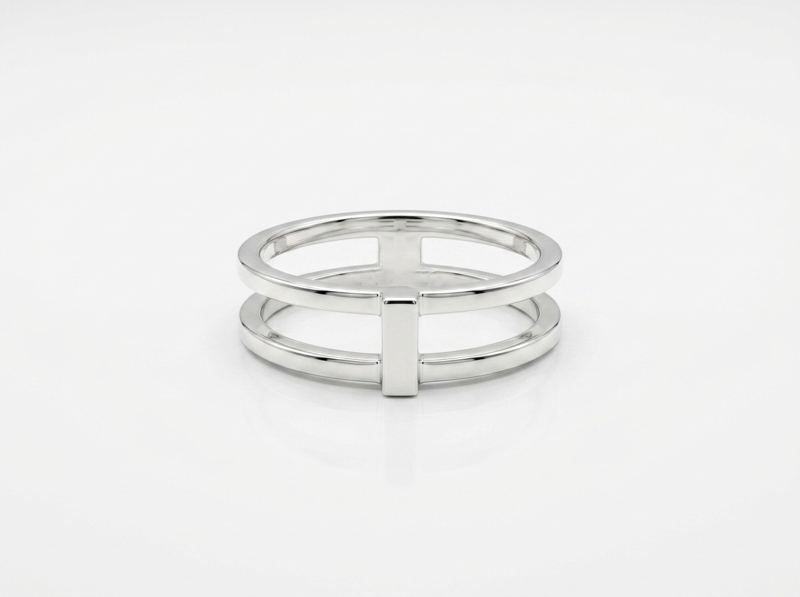
The one genuine technical complaint about Argentium is prongs. Thin sections can be fragile at soldering heat, and a small prong can slump if it is overheated. That is real, and it is why some jewellers avoid the metal.
There is a way around it that does not involve a different alloy.
Argentium can be heat hardened, which sterling cannot be in the same way. So the mount is hardened first, in a kiln, while it is empty. It comes out hard, and only then does the stone go in, cold. The prongs never see soldering heat with a moissanite sitting in them.
Argentium also fuses to itself, which means many joins can be made without solder at all.
So the honest position is that Argentium demands a different sequence, not that it makes bad settings. A workshop that has built that sequence has no prong problem. A workshop treating it like sterling does.
Skin, nickel and the green mark
Two separate things get mixed up here.
The green mark on your finger is usually copper. Copper reacts with sweat and with the acids on skin, and the result transfers. It is not dangerous and it is not an allergy. Argentium has no copper in the alloy, so the usual cause is not there. The longer explanation is here.
A true reaction, itching, redness, a rash, is usually nickel. Sterling itself contains no nickel, but rhodium plating is very often applied over a nickel underlayer, and when the plating wears through, nickel is what reaches your skin. Argentium contains no nickel and carries no plating, so there is no second metal underneath.
If you have reacted to silver jewellery before, that distinction is the one that matters.
What to actually expect after a year
Here is the part most sellers skip.
Argentium tarnishes. It is highly tarnish resistant, up to seven times more than sterling, and its resistance improves with age. It is not tarnish proof, and no silver alloy is.
If you wear it daily you will see it stay bright far longer than sterling. If you leave it in a drawer for a year in a humid climate you will still see something. Anyone promising you a metal that never changes is selling you a claim they cannot honour.
Scratches are a separate question. Silver of any grade is softer than gold or platinum, and a ring worn every day will pick up marks. Argentium is harder than sterling once heat hardened, which helps, but it does not make silver behave like platinum. If scratch resistance is your first priority, silver is the wrong metal regardless of the alloy.
What you should expect: a whiter tone than sterling, no plating to wear through, no green marks, no nickel, and a piece that comes back with a cloth rather than a dip.
What to ask before you buy
| Ask | Why |
|---|---|
| Which grade, 935, 940 or 960? | They are different silver contents and behave differently. It belongs on the receipt |
| Is it stamped? | Genuine Argentium carries the Winged Unicorn mark, the Argentium Guild's own. It is how you verify the metal rather than trust the seller |
| Is it plated? | If it is, you are paying an Argentium price for a coated piece and losing the point |
| Is the mount heat hardened? | The answer tells you whether the workshop knows the alloy |
| Does the moissanite come certified? | Certification is normal and cheap. There is no reason to decline it |
| What is the tarnish claim, exactly? | "Highly tarnish resistant" is honest. "Tarnish proof" is not |
The short version
Moissanite in Argentium is a good combination for everyday wear, and the reasons are specific rather than general. The stone is hard enough that it is not the failure point. The metal has no copper, so the green mark cause is absent. It has no nickel and no plating, so there is nothing to wear through and expose. It is 96 per cent silver at the 960 grade, above the Britannia standard, and whiter than sterling because there is no copper warming it.
What it is not is maintenance free. It is silver, it will mark, and it will eventually show something. The difference is that a cloth fixes it instead of a replating bill.
We make in Argentium 960 only, on a line that has never run sterling, as an Argentium Silver Trademark Registered User, number AS2475. If you are having something made, send us the design and we will quote it with the grade, the weight and the stone spec written down.
Argentium 960 with moissanite and lab grown stones
India’s first house of Argentium silver
Made to order, Winged Unicorn stamped, grade and weight written on every quote. Registered User AS2475.
Ask about a pieceor email toshit@argentia.in