
The short answer.
- Many retailers now sell natural diamonds, lab-grown diamonds and moissanite side by side, as three price levels of the same design.
- In the US, the word diamond on its own means natural. Lab-grown needs a qualifier, and moissanite is a separate stone, not a diamond.
- Natural diamonds should come with invoices carrying the Kimberley Process and System of Warranties statement. Centre stones should come with an IGI or GIA report.
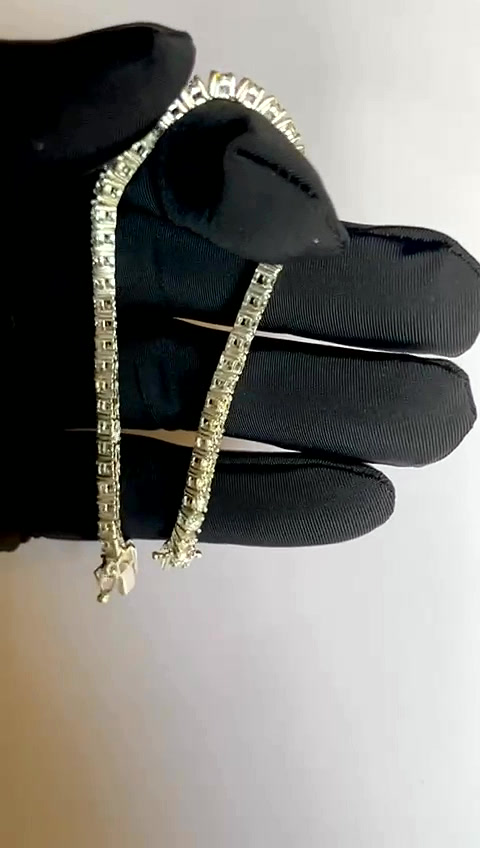
- Argentia sets all three, plus Jaipur coloured gemstones, in Argentium 960 silver. Real examples: a 99.35 ct moissanite chain in 31.53 g and a 5.55 ct lab-grown tennis bracelet in 7.51 g.
In this guide
Many jewellers now sell three kinds of white stone: natural diamonds, lab-grown diamonds and moissanite. Often it is the same tennis bracelet or the same solitaire, offered at three price levels. This guide is for retailers and brands that already sell diamond jewellery and want one manufacturer for all three.
Why retailers now carry all three
Lab-grown prices fell hard. Wholesale lab-grown prices are down about 75% since 2022, which we covered in why diamond prices are falling. Natural diamond prices have fallen too, but the gap between the two is still wide. Moissanite sits below both and has become its own category. More on that in moissanite in silver: what to stock.
The result is a simple ladder. A customer who comes in for a natural diamond tennis bracelet and finds the price too high can buy the same design in lab-grown or moissanite, from the same store, the same day. Without the lower tiers, that sale is often lost.
What you may call each stone
This matters most in the US, where the FTC Jewelry Guides apply, and buyers elsewhere use them as a reference.
| Stone | What it is | How to describe it |
|---|---|---|
| Natural diamond | Mined carbon, hardness 10 | Diamond. The plain word is reserved for natural stones. |
| Lab-grown diamond | The same material, grown by CVD or HPHT, hardness 10 | Laboratory-grown, laboratory-created or [manufacturer name]-created diamond |
| Moissanite | Silicon carbide, hardness 9.25 | Moissanite. Never diamond, with or without a qualifier. |
JCK sums up the rule: the unadorned word diamond can still refer only to a natural, mined gem, so lab-grown stones must always be disclosed. There is a practical trap with moissanite too. The FTC warns that thermal testers may not accurately identify moissanite, which may falsely register as a diamond. When natural and moissanite pieces sit in the same stockroom, labelling at the workshop matters.
Certificates and paperwork
- Natural diamonds. Ask that invoices carry the World Diamond Council System of Warranties statement. The Responsible Jewellery Council describes the System of Warranties as a programme that tracks diamonds through the supply chain after the Kimberley Process certifies them.
- Centre stones. An IGI or GIA report for anything sold as a solitaire or a feature stone. The report number is often laser inscribed on the girdle.
- Melee. The small side stones are usually sold uncertified, by sieve size and grade range. Ask for the grade range in writing and whether it is natural or lab-grown.
- Moissanite. Larger moissanite often comes with its own grading card. The 8 mm stones in our 99.35 ct chain each came with a GRA card showing size, weight and colour.
Why one workshop for all three
A retail guide on diamond suppliers makes the case for range depth: buying rings, bracelets, pendants and earrings from one supplier simplifies procurement, reduces shipping complexity, and strengthens quality consistency across categories. The same logic holds across stone types.
- One CAD, three price points. A design drawn once can be cast and set with any of the three. Only the stone line on the quote changes.
- Matching metal and finish. The natural and lab-grown versions of a bracelet should look identical apart from the price tag. Two workshops rarely match.
- One set of paperwork. Stone descriptions, certificates and invoices come from one place, in one format.
The metal matters more than people expect. White diamonds are usually set in rhodium-plated white metal, and when the plating wears the metal around the stone turns yellow or grey. Argentium 960 is white without plating and resists tarnish, so the setting stays white around the stone. It also heat hardens, which helps prongs hold. More on that in lab-grown diamonds in Argentium silver.
How we source and set stones
For certified stones, we send you the stone's report, photos and 360 video before it is bought, so you approve the actual stone. For melee, we quote the size, grade range and whether it is natural or lab-grown, in writing. We also set stones you supply.
Two pieces we have made show the range. An 18-inch tennis chain carries 99.35 ct of 8 mm moissanite in 31.53 g of Argentium. A lab-grown diamond tennis bracelet carries 5.55 ct of stones in 7.51 g. Both were drawn in CAD first, cast, then set in Jaipur.
Wholesale and private label orders start at 100 grams of finished silver across any mix of designs and stones. Send us the design and the three stone options you want to offer, and we will quote each tier side by side. For compliance documents by market, see our guide for EU, UK and US importers.
Questions buyers ask
Can one supplier make natural diamond, lab-grown diamond and moissanite jewellery?
Yes. The same design can be drawn once in CAD and set with any of the three stones. Argentia makes all three in Argentium 960 silver in Jaipur, along with coloured gemstones, for brands and retailers worldwide.
Can I call a lab-grown diamond a diamond?
Only with a qualifier. Under the FTC Jewelry Guides, the word diamond on its own refers to a natural, mined stone. Use laboratory-grown, laboratory-created or the manufacturer's name followed by created.
Is moissanite a diamond?
No. Moissanite is silicon carbide with a hardness of 9.25, against 10 for diamond. It must be sold as moissanite. Some thermal diamond testers can mistake it for diamond, so it should be labelled clearly at the workshop.
What paperwork should come with natural diamonds?
Invoices should carry the World Diamond Council System of Warranties statement, which follows the Kimberley Process. Centre stones should come with an IGI or GIA grading report.
Why set diamonds in Argentium silver?
Argentium 960 is white without rhodium plating and resists tarnish, so the metal around the stone stays white. It can also be heat hardened so prongs hold. That makes it a good base for diamond, lab-grown and moissanite pieces at silver prices.
Sources
- JCK: How to talk correctly about lab-grown diamonds
- FTC: Advertising diamonds, gemstones and pearls
- Responsible Jewellery Council: Kimberley Process and System of Warranties training
- Alankar Jewels: What to look for when choosing a diamond jewelry supplier
Checked on 16 November 2026. Rules and prices change, so confirm anything you rely on with the source.
Made in our Jaipur workshop
Two pieces, filmed from drawing to finish
The making of one chain · 31 seconds
99.35 carats of moissanite in one chain
Stones graded by GRA, every link drawn in CAD, cast in Argentium 960 and set in our Jaipur workshop. 18 inches, 31.53 g of silver.
See the chainThe making of one ring · 45 seconds
From a photo and CAD to the finished ring
One client sent a photo and his own blue sapphire. We drew the ring in CAD, cast it, polished it and set his stone, and filmed every stage.
Read the full storyFor diamond jewellery retailers and brands
India’s first house of Argentium silver
Argentium 960 only, Winged Unicorn stamped, Registered User AS2475. Natural diamonds, lab-grown diamonds, moissanite and Jaipur gemstones. Wholesale and private label from 100 g across any mix of designs.
Quote three tiersor email toshit@argentia.in